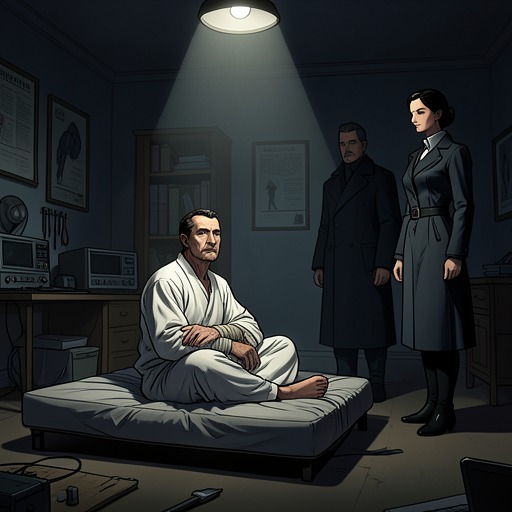
Oscar Bane False Attack Scene Incident
Kay ScarpettaOscar Bane staged an attack as a calculated false narrative around Terri Bridges’s death. He presented himself as a wounded man who had entered her unlocked apartment, discovered her bound in the bathroom, and been assaulted by an intruder. In reality, he had manufactured the evidence of an attack after Terri was dead, using the scene to redirect suspicion and to make contact with Kay Scarpetta under circumstances he could control.
Purpose and Circumstances
The immediate purpose of the staging was personal as well as forensic. Oscar told Scarpetta that fabricating an attack was the only way to bring her to him. He expected that, if he were treated by Benton Wesley, he could ask for Scarpetta, because he trusted her and believed she was the only person who cared about Terri. The false emergency therefore served two objectives at once: it supplied a plausible explanation for his injuries and created a protected route to the one investigator whose attention he wanted.
The deception also drew on a wider pattern of killings. Earlier victims included a fourteen-year-old boy from Greenwich, Connecticut, found naked, bound at the wrists and ankles, and strangled with an object that was never recovered, and a twenty-one-year-old woman who had moved from North Carolina to Baltimore and whose body was found in a harbor dumpster after a similarly unresolved strangulation. Both cases occurred in the summer of 2003, two months apart, and neither produced useful DNA or a suspect. Later, Terri’s case was linked to the same pattern through the thin ten-karat herringbone anklet placed around her ankle, a possible memento or mark of ownership rather than an accidental ornament.
Construction of the False Scene
Oscar described an intruder who did not exist. He said that all the lights had been off when he arrived, that Terri’s door was unlocked, and that he ran inside calling for her. He claimed that the bathroom light was on, apparently arranged to shock whoever found her, although the room could not be seen from the street because it was at the back of the apartment. The details gave his account the surface texture of an observed crime scene while quietly placing Oscar in control of every important discovery.
He said he cut the restraints from Terri’s wrists with kitchen scissors. He then claimed that he accidentally cut his thumb while reaching for the scissors after the knife block fell over, wrapped the thumb in kitchen paper, ran back to his car, and threw his jacket inside. Only after removing the jacket, according to the story he constructed, did he sit beside Terri on the bathroom floor, tear off his shirt, and injure himself. Blood on the shirt was intended to authenticate the account of a struggle.
The flashlight was another planted detail. Oscar said that he found it in a kitchen drawer, wiped it clean, and left it on the living-room floor near the door. When Scarpetta asked why he had removed fingerprints and DNA from an object in an apartment where his biological traces would already be widespread, he explained that the cleaning was meant to support his claim that the intruder had worn gloves. He specifically invoked leather gloves, using the absence of prints on the flashlight as supposed corroboration rather than as an obvious sign of manipulation.
The scissors remained on the bathroom floor after he used them to cut Terri free. Oscar said that Terri’s hands had been bound so tightly that they were dark blue and red, with blue fingernails, and that he had rubbed her wrists and hands to restore circulation and remove the deep marks. His account concentrated on the physical distress of the restrained victim, a detail that could make him appear compassionate while also explaining why his own handling of the body and the restraints would have left extensive contact evidence.
Scarpetta’s Reconstruction
Scarpetta did not accept the scene at face value. She observed that Oscar could reach every part of his own body and confronted him with the possibility that he had made the scratches and bruises himself. The injuries occupied precisely the positions they would have occupied if he had inflicted them on himself, and she arranged for the impressions to be studied under a microscope in a police laboratory rather than treating his explanation as settled fact.
Her reconstruction exposed the staging as a sequence of practical decisions. Oscar needed his jacket out of the way before creating damage to his shirt and body; otherwise, the injuries would not have made sense. He therefore had to return to the car and put the jacket inside after injuring himself or while arranging the story around those injuries. The supposed intruder, meanwhile, had no independent existence: the darkness, the unlocked door, the bathroom light, the cleaned flashlight, and the self-inflicted wounds were all parts of a single account designed to survive police scrutiny.
The scene’s contradiction lay in Oscar’s attempt to make himself both witness and victim. He wanted the police to see him as someone attacked while investigating Terri’s death, yet the very precision of his injuries made them evidence of authorship. Scarpetta’s question about whether he had struck himself with the flashlight forced the object back into the chain of fabrication: it was not merely something found at the doorway, but a prop selected, cleaned, and positioned to supply the missing assailant.
Deception, Pattern, and Consequences
The staged attack temporarily protected Oscar by converting his presence at the apartment into apparent proof of innocence. It also helped explain why his shirt was torn and why he had suffered visible injuries. Yet the performance could not erase the larger pattern. Terri had been bound at the wrists, as the earlier victims had been; the unexplained strangulation method and the golden anklet connected her death to the older cases; and later disclosures identified Mike Morales as the killer responsible for Bethany, Rodrick, and Terri. Morales had used latex gloves, the same lubricant, and Aqualine ointment in the murders, while Terri’s case supplied the recurring restraints and symbolic anklet that investigators recognized as part of the serial pattern.
Oscar’s fabrication thus occupies an unstable position in the investigation. It was not the act that established the serial killer’s identity, but it shaped the initial interpretation of Terri’s death and delayed a clean distinction between victim, witness, and suspect. His confession of the staging gave Scarpetta access to the scene’s hidden mechanics, while his attempt to summon her revealed his dependence on her judgment. The false attack failed as a perfect crime because it contained the human weakness he was trying to conceal: a carefully designed story still required him to remember, explain, and physically reproduce every step of the invented assault.
Narrative Significance
The event turns the crime scene into a theater of competing narratives. Oscar arranges bodies, objects, lighting, clothing, and wounds as though each were a line in a script; Scarpetta reads the same arrangement as a sequence of actions rather than as a completed story. The cleaned flashlight and the discarded jacket are especially important because they expose the difference between appearance and process. What looks like evidence of an unknown attacker becomes evidence of Oscar’s effort to make an attacker imaginable.
The staging also reverses the usual logic of discovery. Oscar claims that he found Terri, but his account makes him the person who determines how she will be found. He invokes her suffering, the supposed intruder, and the danger he allegedly faced, yet each element leads back to his management of the scene. By forcing Scarpetta to reconstruct the order of his movements, the investigation changes the value of the event from apparent exoneration to incriminating disclosure: the attack was never real, but the attempt to fabricate it reveals Oscar’s calculation, his fear of being blamed, and his determination to bring Scarpetta into the case on his own terms.